Blog, Crystal Guide
How Can You Tell if a Crystal Bracelet Is Good Quality?
How Can You Tell if a Crystal Bracelet Is Good Quality?
Quick Answer: You can assess a crystal bracelet’s quality by checking accurate material descriptions, well-finished beads and drill holes, secure construction, comfortable fit, and clear seller policies. Look for chips, sharp edges, frayed cord, loose fittings, and unexplained differences between the listing and the item. Judge color and transparency according to the named stone rather than expecting every bead to be perfectly clear. Photographs, coolness to the touch, and visible inclusions cannot independently prove natural origin. If authenticity materially affects the price, ask what evidence supports the claim and consider an appropriate independent gemological report. Good quality combines honest disclosure with workmanship suited to everyday use.
Crystal Bracelet Quality at a Glance
| Product type | Beaded jewelry; assess the stones and the complete assembled bracelet. |
|---|---|
| Materials in the examples below | Seller-listed clear quartz and amethyst, with additional decorative components disclosed by product. |
| Verified size examples | Approximately 6 mm clear quartz with 9–10 mm amethyst accents; a separate multi-wrap listing specifies 6.5 mm main beads. |
| Useful visual checks | Surface finish, bead-hole edges, cord condition, fastening, and agreement with the description. |
| What appearance cannot establish alone | Natural origin, treatment status, or the identity of every component. |
| Fit | Confirm wearable wrist range separately from bead diameter. |
| Care | Follow instructions for the stones, cord, coatings, and other components together. |

Is gemstone authenticity the same as bracelet quality?
No. Authenticity concerns whether the material matches its description; bracelet quality also includes finishing, assembly, and wearability. A natural gemstone bracelet can have chipped holes or weak construction. A clearly disclosed laboratory-grown or imitation material can be neatly made, although it should not be sold as a different material.
Natural origin does not guarantee good workmanship. Ask two separate questions: “What is it made of?” and “How well is it made?” GIA explains synthetic gem materials as laboratory-made materials sharing essentially the characteristics of their natural counterparts. An imitation resembles another gem without necessarily sharing those properties.
For broader style choices after checking quality, use the crystal bracelet buying guide.
What should a trustworthy material description include?
A useful listing names each significant material, explains relevant treatments or finishes, and distinguishes gemstones from decorative accents. “Crystal,” “premium,” and a symbolic product name are not enough to identify a bead. If a trade name leaves the composition unclear, ask the seller to explain it before ordering.
- Stone identity: the actual material rather than only its color.
- Origin claims: whether natural or laboratory-grown status is being claimed and what supports it.
- Treatments: disclosed dyeing, coating, filling, or other relevant enhancement.
- Other components: spacers, plating, pearl-like accents, cord, and fastening.
A treatment is not automatically a defect; undisclosed treatment can make a buying decision misleading. Ask about care implications as well as appearance. Review the Materials & Authenticity Policy alongside the individual listing, because a general policy does not answer every product-specific question.
Which visible details indicate good or poor workmanship?
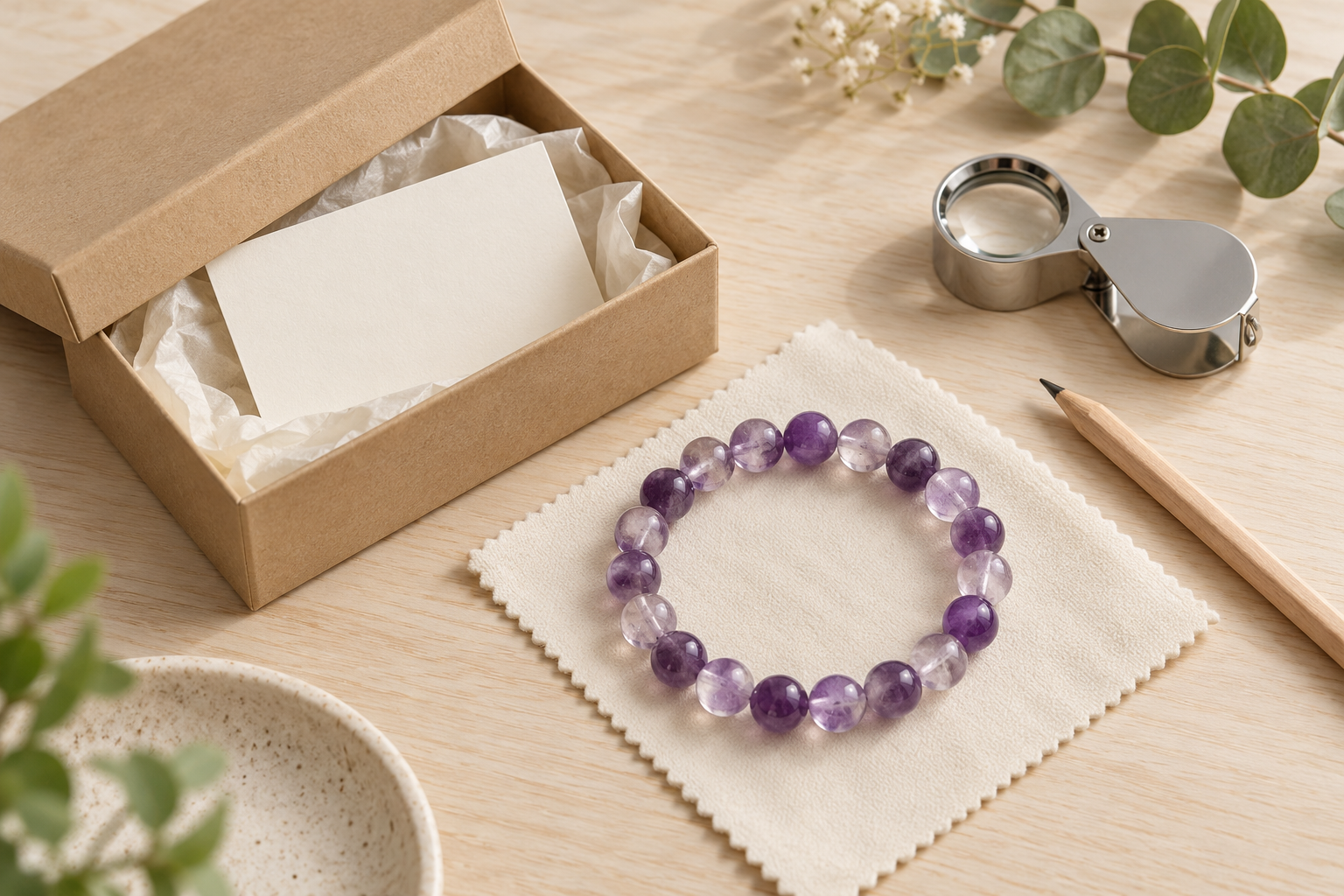
Look for a finish appropriate to the design, clean bead-hole edges, intact cord, and fittings that operate correctly. Inspect the bracelet under ordinary diffuse light and from several angles. A close-up can reveal damage or rough finishing, but it should not be treated as a laboratory identification test.
| Check | Reassuring observation | Reason to ask or pause |
|---|---|---|
| Bead surface | Finish matches the stated polished, matte, or carved design | Sharp chips, unexpected scratches, or peeling surface layers |
| Drill holes | Edges appear clean and cord passes without obvious abrasion | Jagged edges, chipped openings, or fraying at contact points |
| Assembly | Beads sit as intended; fastening works and cord is intact | Loose components, visible cord damage, or a clasp that will not close |
| Color and arrangement | Variation fits the description and design | Unexplained mismatch with the advertised item |
| Disclosure | Specific materials and useful answers to questions | Vague grades used instead of specifications |
Use these checks while comparing materials and construction details.
Explore Crystal Bracelet Designs
Do cloudy beads or inclusions mean poor quality?
Not necessarily. Transparency and internal features need to be judged in the context of the material. GIA describes the characteristic cloudy translucence of many rose quartz examples as related to inclusions. Applying a “perfectly clear is always better” rule to every gemstone can lead to poor comparisons.
See GIA’s rose quartz description for the distinction. Internal cloudiness is different from a chipped surface or an open fracture, although a photograph may not make the difference obvious. Ask for another view when a feature is unclear.
Inclusions alone do not prove that a bead is natural. A GIA investigation of synthetic quartz documented internal features resembling those in natural quartz. Treat visual observations as clues, not a definitive origin test.
How can you assess the cord, clasp, and fit?
Inspect construction without deliberately overstretching or pulling the bracelet apart. Look for frayed fibers, damaged elastic, loose connections, and a fastening that does not close properly. Ask for the finished wrist range and the seller’s measuring method; bead diameter alone does not establish fit.
A hidden knot may look tidy, but it does not prove the cord is strong. Similarly, a thicker-looking cord does not establish its material or expected lifespan. If construction details are absent, ask whether restringing or repair support is available.
Bead diameter and wearable wrist size are separate specifications. For a gift, obtain a wrist measurement or confirm an exchange arrangement. Read the women’s bracelet selection guide for proportion and style considerations.

What do real product listings help you compare?
Real listings let you compare disclosed dimensions and components, then identify unanswered questions. They do not replace an examination of the delivered item. The following examples illustrate how to read specifications; they are not independently tested quality rankings or claims that one bracelet is more authentic than another.
Yiling Taiyishan is a Chinese culture-inspired jewelry and lifestyle brand offering crystal bracelets, incense bead bracelets, Five Elements-inspired designs, crystal decor, and related cultural products.
| Example | Seller-disclosed details | Questions before buying |
|---|---|---|
| Clear Quartz & Amethyst Bracelet | Approximately 6 mm clear quartz, 10 mm deep amethyst, 9 mm lavender amethyst, and 5 mm shell pearl accents | What are the finished fit, cord material, treatment disclosures, and exact composition of the shell pearl accents? |
| Amethyst Pixiu Multi-Wrap Bracelet | Amethyst, “yellow tower crystal,” southern red agate spacers, and an amethyst Pixiu; 6.5 mm main beads listed | What is the precise identity of “yellow tower crystal,” and what are the total length, fastening, and wearable wrist range? |
Different bead sizes can be an intentional design choice. “Shell pearl” should not be assumed to mean natural or cultured pearl. Specific measurements help comparison, but they do not authenticate the materials.
Compare disclosed components with the details that matter for your own purchase.
Review Bracelet SpecificationsDo price, “AAA” labels, or certificates prove quality?
No single price or label proves quality. Ask what a grade measures, who assigned it, and whether the evidence relates to the bracelet being sold. An identification report and a seller’s quality grade answer different questions. Neither automatically establishes the strength of the cord or the quality of assembly.
GIA states that it evaluates but does not grade rose quartz; its identification report addresses material characteristics, natural or laboratory-grown status, and detectable treatments. Do not interpret an unexplained “AAA” listing as a GIA grade.
For a report, check the issuing organization, report number, verification method, item description, and scope. A result for one bead should not automatically be extended to every bead. Compare the total delivered price only after clarifying materials, construction, fit, and return terms.
What should you do when the bracelet arrives?
Check the unworn bracelet promptly against the listing and order details. Keep packaging and photograph any damage or unexplained mismatch before attempting cleaning, repairs, or alterations. Contact the seller within the applicable return period and follow its instructions rather than trying to fix a newly delivered defect yourself.
- Compare the overall design, components, and stated measurements.
- Inspect surfaces, bead openings, cord, and fastening in good light.
- Record unclear features with close photographs.
- Resolve concerns before wearing or modifying the item.
The current return policy specifies requests within seven days of receipt for eligible unused items in original condition and packaging, with exclusions including customized and worn items. Review the current terms before ordering.
Frequently Asked Questions
Can I tell if a bracelet is real because it feels cold?
No. Coolness alone cannot identify a bead or prove natural origin. Its starting temperature, size, surroundings, and how long you have held it can affect the sensation. Treat touch as a comfort observation rather than an authentication method. Ask for a precise material description and supporting evidence when origin matters to your purchase; do not pay a premium solely because a seller demonstrates a cold-touch test.
Should I use a scratch or flame test?
No. Do not scratch, heat, burn, or chemically test a finished bracelet at home. You could damage beads, coatings, cord, or fittings without establishing a reliable identification. A damaged item may also fall outside the seller’s return conditions. Use non-destructive visual checks to assess workmanship, and consult a qualified gemological professional when the material identity needs to be established beyond the seller’s description.
Are perfectly matching beads a sign of fake crystals?
No. Matching appearance alone does not establish that beads are fake. Beads may be selected and arranged for a consistent design, while differences between beads do not automatically prove natural origin either. Compare what you receive with the listing’s explanation of color and variation. If the appearance seems inconsistent with the material claim, ask for clarification or appropriate testing rather than reaching a conclusion from uniformity alone.
Is a heavier bracelet better quality?
No. Weight is not a standalone quality score. Bead dimensions, bead count, material, and added components all affect how heavy a bracelet feels. A heavier piece may also be less comfortable for the intended wearer. Compare weight only alongside an accurate description and measurements. If comfort matters, ask for the actual product weight rather than assuming that a photograph or a broad size label answers that question.
Does every crystal bracelet need a laboratory report?
No. Whether a report is worthwhile depends on the purchase value and the importance of the material claims to you. A modest decorative purchase may be adequately assessed through clear disclosure, workmanship checks, and reasonable return terms. If a substantial premium depends on natural origin or treatment status, stronger evidence may be appropriate. Confirm with the laboratory what can be tested and whether its report covers the complete bracelet.
Will a good-quality bracelet last forever?
No. Good workmanship does not make a bracelet immune to impact, wear, or component deterioration. Care depends on the entire piece, including cord, metal, and any treatments. Follow product-specific instructions and inspect connections periodically. The crystal bracelet care guide explains routine handling, while the everyday wear guide helps you choose a style suited to your routine. No universal lifespan should be assumed from a gemstone name.
Choose with clear information. Confirm materials, inspect workmanship, check fit, and understand after-sales terms before buying.
Shop Crystal BraceletsRelated Reading
- How to Choose a Crystal Bracelet
- How Do I Choose a Crystal Bracelet for Women?
- What Is the Best Crystal Bracelet for Everyday Wear?
- How to Clean and Care for Crystal Bracelets
- Crystal Bracelet Gifts for a Girlfriend
Cultural & Product Disclaimer
Cultural, symbolic, and traditional meanings are presented for cultural education, lifestyle reference, personal reflection, and product understanding. They are not medical or financial advice and do not guarantee spiritual, relationship, or life outcomes. Crystals are decorative and cultural accessories, not treatments or tools that guarantee changes in real-world results. This buying guide is not a laboratory identification or certification of any product. Confirm current specifications and policies before purchase.